
Blog entry by Sandika Madushan
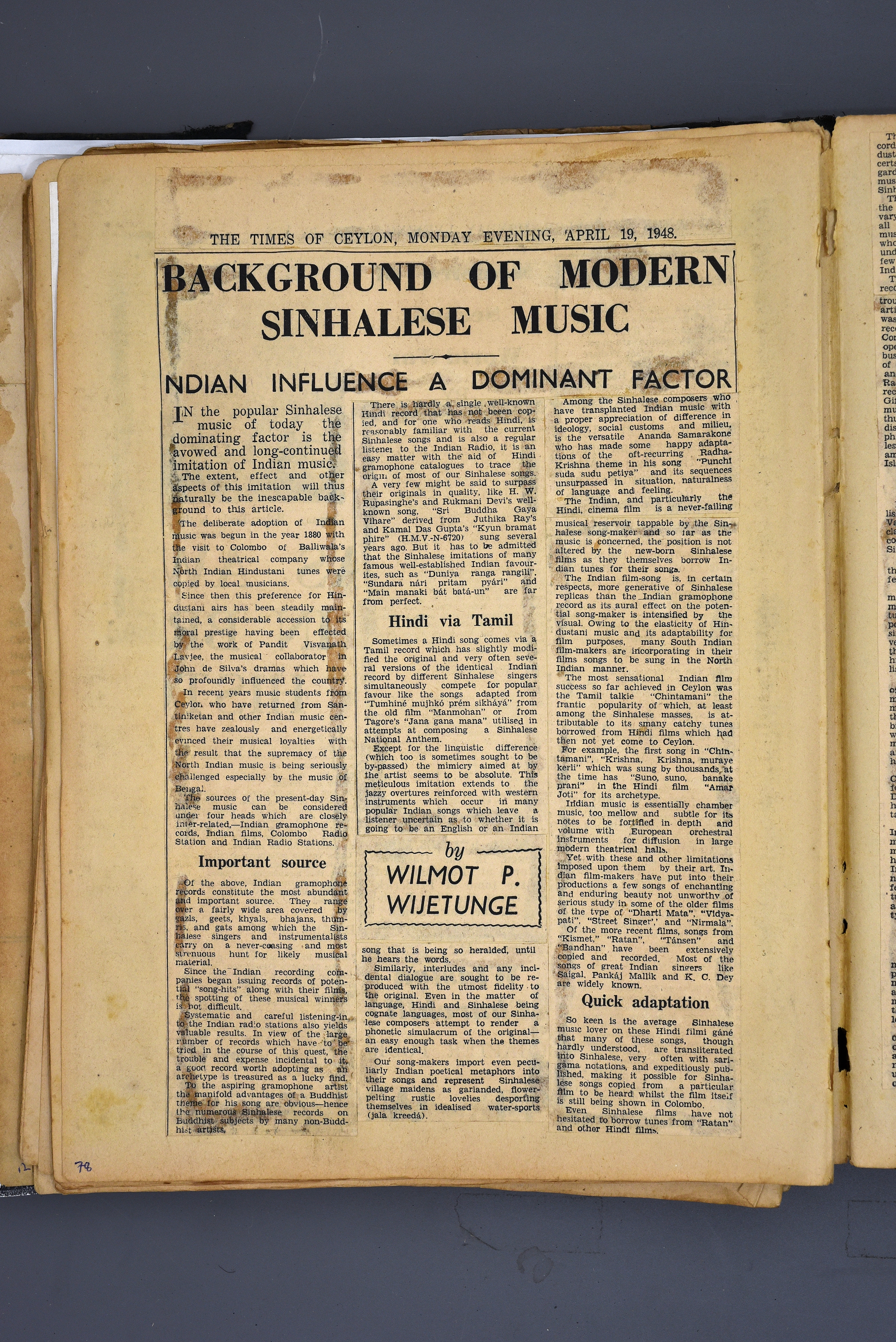
THE TIMES OF CEYLON, MONDAY EVENING, APRIL 19, 1948.
BACKGROUND OF MODERN
SINHALESE MUSIC
NDIAN INFLUENCE A DOMINANT FACTOR
IN the popular Sinhalese music of today the dominating factor is the avowed and long-continued imitation of Indian music.
The extent, effect and other aspects of this imitation will thus naturally be the inescapable background to this article.
The deliberate adoption of Indian music was begun in the year 1880 with the visit to Colombo of Balliwala's Indian theatrical company whose North Indian Hindustani tunes were copied by local musicians.
Since then this preference for Hindustani airs has been steadily maintained, a considerable accession to its moral prestige having been effected by the work of Pandit Visvanath Laviee, the musical collaborator in John de Silva's dramas which have so profoundly influenced the country.
In recent years music students from Ceylon. who have returned from Santiniketan and other Indian music centres have zealously and energetically evinced their musical loyalties with the result that the supremacy of the North Indian music is being seriously challenged especially by the music of Bengal.
The sources of the present-day Sinhalese music can be considered under four heads which are closely inter-related,-Indian gramophone records, Indian films, Colombo Radio Station and Indian Radio Stations.
Important source
Of the above, Indian gramophone records constitute the most abundant and important source. They range over a fairly wide area covered by gazls, geets, khyals, bhajans, thumris, and gats among which the Sinhalese singers and instrumentalists carry on a never-ceasing and most strenuous hunt for likely musical material.
Since the Indian recording companies began issuing records of potential "song-hits" along with their films, the spotting of these musical winners is not difficult.
Systematic and careful listening-in to the Indian radio stations also yields valuable results. In view of the large rumber of records which have to be tried in the course of this quest, the trouble and expense incidental to it, a good record worth adopting as an archetype is treasured as a lucky find.
To the aspiring gramophone artist the manifold advantages of a Buddhist theme for his song are obvious-hence the numerous Sinhalese records on Buddhist subjects by many non-Budd- hist artists.
There is hardly a single well-known Hindi record that has not been copied, and for one who reads Hindi, is reasonably familiar with the current Sinhalese songs and is also a regular listener to the Indian Radio, it is an easy matter with the aid of Hindi gramophone catalogues to trace the origin of most of our Sinhalese songs.
A very few might be said to surpass their originals in quality, like H. W. Rupasinghe's and Rukmani Devi's well-known song, "Sri Buddha Gaya Vihare" derived from Juthika Ray's and Kamal Das Gupta's "Kyun bramat phire" (H.M.V.-N-6720) sung several years ago. But it has to be admitted that the Sinhalese imitations of many famous well-established Indian favourites, such as "Duniya ranga rangili", "Sundara nári pritam pyári" and "Main manaki bát batá-un" are far from perfect.
Hindi via Tamil
Sometimes a Hindi song comes via a Tamil record which has slightly modified the original and very often several versions of the identical Indian record by different Sinhalese singers simultaneously compete for popular favour like the songs adapted from "Tumhiné mujhkó prém sikháyá" from the old film "Manmohan" or from Tagore's "Jana gana mana" utilised in attempts at composing a Sinhalese National Anthem.
Except for the linguistic difference (which too is sometimes sought to be by-passed) the mimicry aimed at by the artist seems to be absolute. This meticulous imitation extends to the jazzy overtures reinforced with western instruments which occur in many popular Indian songs which leave a listener uncertain as to whether it is going to be an English or an Indian song that is being so heralded, until he hears the words.
Similarly, interludes and any incidental dialogue are sought to be reproduced with the utmost fidelity to the original. Even in the matter of language, Hindi and Sinhalese being cognate languages, most of our Sinhalese composers attempt to render a phonetic simulacrum of the original-an easy enough task when the themes are identical.
Our song-makers import even peculiarly Indian poetical metaphors into their songs and represent Sinhalese village maidens as garlanded, flower- pelting rustic lovelies desporting themselves in idealised water-sports (jala kreedá).
Among the Sinhalese composers who have transplanted Indian music with a proper appreciation of difference in ideology, social customs and milieu, is the versatile Ananda Samarakone who has made some happy adaptations of the oft-recurring Radha- Krishna theme in his song "Punchi suda sudu petiya" and its sequences unsurpassed in situation, naturalness of language and feeling.
The Indian, and particularly the Hindi, cinema film is a never-failing musical reservoir tappable by the Sinhalese song-maker and so far as the music is concerned, the position is not altered by the new-born Sinhalese films as they themselves borrow Indian tunes for their songs.
The Indian film-song is, in certain respects, more generative of Sinhalese replicas than the Indian gramophone record as its aural effect on the potential song-maker is intensified by the visual. Owing to the elasticity of Hindustani music and its adaptability for film purposes, many South Indian film-makers are incorporating in their films songs to be sung in the North Indian manner.
The most sensational Indian film success so far achieved in Ceylon was the Tamil talkie "Chintamani" the frantic popularity of which, at least among the Sinhalese masses, is attributable to its smany catchy tunes borrowed from Hindi films which had then not yet come to Ceylon.
For example, the first song in "Chintamani", "Krishna, Krishna, muraye kerli" which was sung by thousands, at the time has "Suno, suno, banake prani" in the Hindi film "Amar Joti" for its archetype.
Iridian music is essentially chamber music, too mellow and subtle for its notes to be fortified in depth and volume with European orchestral instruments for diffusion in large modern theatrical halls.
Yet with these and other limitations Imposed upon them by their art, Indian film-makers have put into their productions a few songs of enchanting and enduring beauty not unworthy of serious study in some of the older films of the type of "Dharti Mata", "Vidyapati", "Street Singer',' and "Nirmala".
Of the more recent films, songs from "Kismet," "Ratan", "Tansen" and "Bandhan" have been extensively copied and recorded, Most of the songs of great Indian singers like Saigal, Pankaj Mallik and K. C. Dey are widely known.
Quick adaptation
So keen is the average Sinhalese music lover on these Hindi filmi gáné that many of these songs, though hardly understood, are transliterated into Sinhalese, very often with sarigama notations, and expeditiously published, making it possible for Sinhalese songs copied from a particular film to be heard whilst the film itseif is still being shown in Colombo.
Even Sinhalese films have not hesitated to borrow tunes from "Ratan" and other Hindi films,
The broadcasts of Hindustani reords, relays of Indian stations for Hinustani music and Hindustani conerts of the Colombo Radio are regarded by the Sinhalese listener. musically, as an integral part of the Sinhalese programme.
The Colombo Station has engaged the services of many amateurs of verying degrees or ability and almost all professional exponents. of Indian music residing in Ceylon, many of whom are Sinhalese who have undergone training in India and a few of whom are highly qualified in Indian music.
The making of the earliest Sinhalese records was a most expensive and troublesome procedure for which artistes had to go to Madras, and this was how John de Silva's songs were recorded by the Odeon Gramophone Company. But after this firm ceased operations in Ceylon, the recording business passed latterly into the hands of two firms located in India-H.M.V. and Colombia-until the Colombo Radio Station also recently began to record the songs of some of its artistes. Gifted Sunil Shanta, one of the leading musical personalities of the day, has thus recorded several songs of great distinction, delicacy and feeling phrased in facile and expressive Sinhalese and these songs are being sung among all all classes throughout the Island
Strange phenomenon
Many of these songs have bean published in two booklets entitled "Ridee Valava" and "Sunil Handa' and are claimed by Sunil Shanta to be original compositions of his own based on old Sinhalese music.
Most of the prominent singers over the radio are joined in part singing by female singers of ability.
A strange and unpleasant phenomenon in contemporary Sinhalese music is the manner in which the tunes of songs which have captured the popular fancy are copied by other singers who make and sing plausible Verbal facsimiles of the original "hits", thereby creating a deadly monotony highly resented by the discriminating listener.
Whatever may be the ethical aspects of what looks to the lay mind very much like musical parasitism, if not musical piracy. the inevitable effect of this practice is to swamp songs of combined musical and literary merit that would otherwise settle down permanently in the popular mind. Would any of John de Silva's valuable songs have survived such a practice?
Hindustani concerts arranged by the Colombo Radio Station are eagerly followed by the Sinhalese listener and Dr. R. Pestonjee's Hindustani concerts have unearthed des unsuspected musical talent of a high order.
In view of the universal imitation of Indian music, it might be thought that many Sinhalese would try to drink, by means of the radio, from the fountainhead itself so easily provided by the Indian Radio Stations, But this is not generally practised, except by professional musicians desirous of locating tunes for the purpose of making songs as the imitation extends only to certain types of Indian music.
Handful of devotees
Even if the highest kinds of Indian music are not available to the microphone, the variety and extent of Indian music that is radiated is wide enough as revealed by that admirable radio magazine, "The Indian Listener". But the more serious Indian muste is followed, perhaps, by a mere handful.
Whether music is a universal languageor not. this adopted musical language of the Sinhalese, with all its faults, approximates infinitely closer to their national psychology and cultural makeup than the comparatively alien music of the West.
Considering the many affinities-religious, ethnological, linguistic, cultural-existing between India and Lanka, nothing is more natural than the existence of a marked similarity in their respective languages of emotion expressed through the highest of human arts. Nor should we be surprised at any influence exerted by the fully-developed Indian music over a basically kindred music whose natural growth has been arrested by various causes.
Possessing as she does fundamentally the same sub-structure as the Indian system, proud Free Lanka with her musical development retarded by what- ever historical causes, need not be so false to her own nature as to be an undignified, witless and frustrated mimic. This insensate, degrading mimicry cannot be the emotional language interpretative of the nation's inmost collective feelings as a true national music ought to be.
This conscious emotional falsification in the plane of sound, which is one of the most potent and mysterious forces in Nature, has to be viewed in the light of a humiliating national psychosis.
The lack of a true national music is an aching void in the nation viewed as a cultural and spiritual organism. Therefore, accepting the Indian musical theory in all its amplitude, it should not be difficult for Lanka with its accumulated spiritual experience and present resources to rear on its pristine musical foundations a musical structure vibrating in harmony with its own peculiar genius and traditions that would eventually be regarded by Asia and the world, if not with admiration, then at least with respect.
by
WILMOT P.
WIJETUNGE