
Blog entry by Sandika Madushan
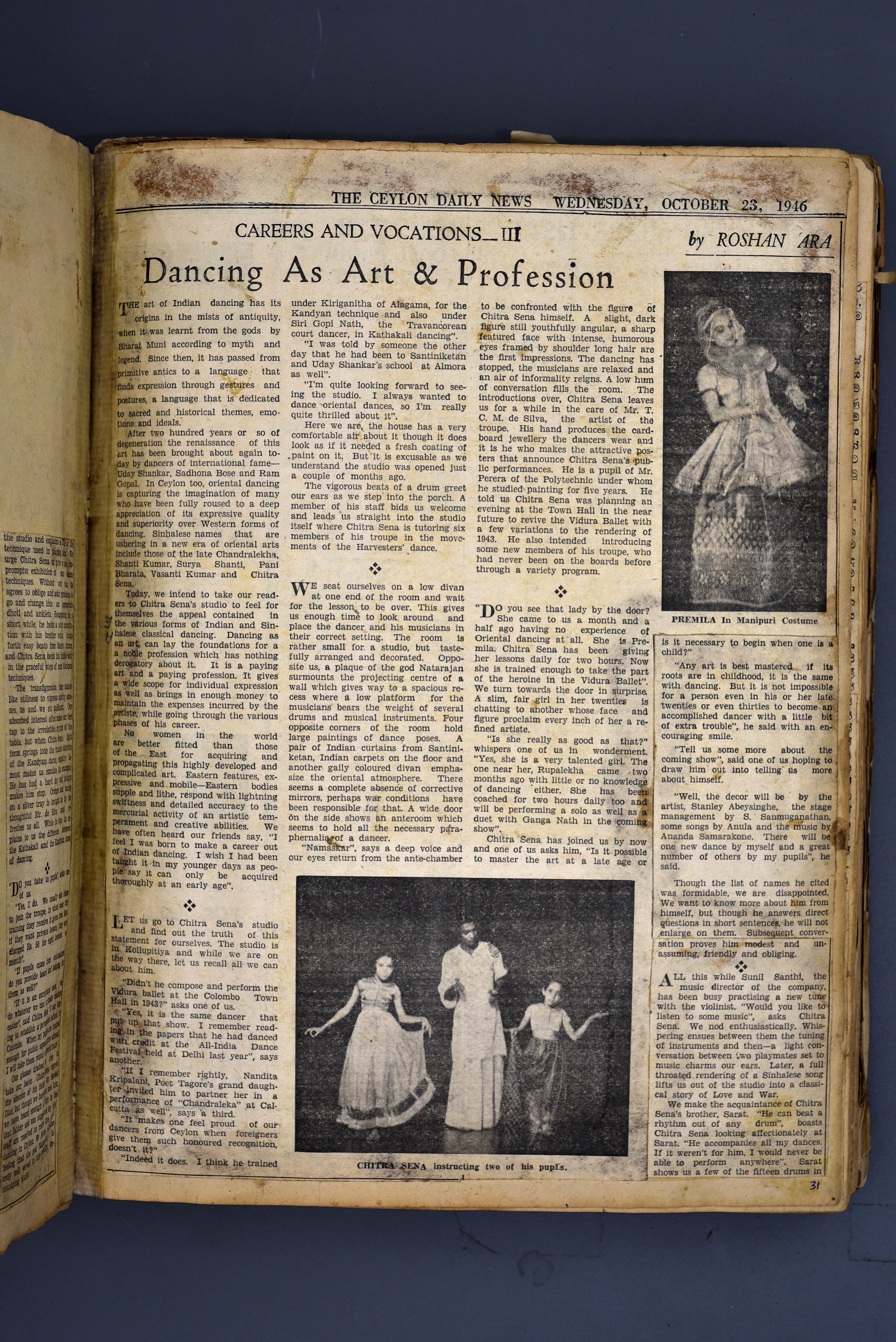
THE CEYLON DAILY NEWS WEDNESDAY, OCTOBER 23, 1946
CAREERS AND VOCATIONS_III by ROSHAN ARA
Dancing As Art & Profession
THE art of Indian dancing has its origins in the mists of antiquity, when it was learnt from the gods by Bharat Muni according to myth and legend. Since then, it has passed from primitive antics to a language that finds expression through gestures and postures, a language that is dedicated to sacred and historical themes, emotions and ideals.
After two hundred years or so of degeneration the renaissance of this art has been brought about again today by dancers of international fameUday Shankar, Sadhona Bose and Ram Gopal. In Ceylon too, oriental dancing is capturing the imagination of many who have been fully roused to a deep appreciation of its expressive quality and superiority over Western forms of dancing. Sinhalese names that are ushering in a new era of oriental arts include those of the late Chandralekha, Shanti Kumar, Surya Shanti, Pani Bharata, Vasanti Kumar and Chitra Sena.
Today, we intend to take our readers to Chitra Sena's studio to feel for themselves the appeal contained in the various forms of Indian and Sinhalese classical dancing. Dancing as an art, can lay the foundations for a noble profession which has nothing derogatory about it.
It is a paying art and a paying profession. It gives a wide scope for individual expression as well as brings in enough money to maintain the expenses incurred by the artiste, while going through the various phases of his career.
No women in the world are better fitted than those of the East for acquiring and propagating this highly developed and complicated art. Eastern features, expressive and mobile-Eastern bodies supple and lithe, respond with lightning swiftness and detailed accuracy to the mercurial activity of an artistic temperament and creative abilities. We have often heard our friends say, "I feel I was born to make a career out of Indian dancing. I wish I had been taught it in my younger days as people say it can only be acquired thoroughly at an early age".
LET us go to Chitra Sena's studio and find out the truth of this statement for ourselves. The studio is in Kollupitiya and while we are on the way there, let us recall all we can about him.
"Didn't he compose and perform the Vidura ballet at the Colombo Town Hall in 1943?" asks one of us.
"Yes, it is the same dancer that put up that show. I remember reading in the papers that he had danced with credit at the All-India Dance Festival held at Delhi last year", says another.
"If I remember rightly, Nandita Kripalani, Poet Tagore's grand daughter invited him to partner her in a performance of "Chandraleka" at Calcutta as well", says a third.
"It makes one feel proud of our dancers from Ceylon when foreigners give them such honoured recognition, doesn't.it?"
"Indeed it does. I think he trained
under Kiriganitha of Alagama, for the Kandyan technique and also under Siri Gopi Nath, the Travancorean court dancer, in Kathakali dancing".
"I was told by someone the other day that he had been to Santiniketan and Uday Shankar's school at Almora as well".
"I'm quite looking forward to seeing the studio. I always wanted to dance oriental dances, so I'm really quite thrilled about it".
Here we are, the house has a very comfortable air about it though it does look as if it needed a fresh coating of paint on it. But it is excusable as we understand the studio was opened just a couple of months ago.
The vigorous beats of a drum greet our ears as we step into the porch. A member of his staff bids us welcome and leads us straight into the studio itself where Chitra Sena is tutoring six members of his troupe in the movements of the Harvesters' dance.
WE seat ourselves on a low divan at one end of the room and wait for the lesson to be over. This gives us enough time to look around and place the dancer and his musicians in their correct setting. The room is rather small for a studio, but tastefully arranged and decorated. Opposite us, a plaque of the god Natarajan surmounts the projecting centre of a wall which gives way to a spacious recess where a low platform for the musicians bears the weight of several drums and musical instruments. Four opposite corners of the room hold large paintings of dance poses. A pair of Indian curtains from Santini- ketan, Indian carpets on the floor and another gaily coloured divan emphasize the oriental atmosphere.
There seems a complete absence of corrective mirrors, perhaps war conditions have been responsible for that. A wide door on the side shows an anteroom which seems to hold all the necessary paraphernalia of a dancer.
"Namaskar", says a deep voice and our eyes return from the ante-chamber to be confronted with the figure of Chitra Sena himself. A slight, dark figure still youthfully angular, a sharp featured face with intense, humorous eyes framed by shoulder long hair are
the first impressions. The dancing has stopped, the musicians are relaxed and an air of informality reigns. A low hum of conversation fills the room. The introductions over, Chitra Sena leaves us for a while in the care of Mr. T. C. M. de Silva, the artist of the troupe. His hand produces the cardboard jewellery the dancers wear and it is he who makes the attractive posters that announce Chitra Sena's public performances. He is a pupil of Mr.Perera of the Polytechnic under whom he studied painting for five years. He told us Chitra Sena was planning an evening at the Town Hall in the near future to revive the Vidura Ballet with a few variations to the rendering of 1943. He also intended introducing some new members of his troupe, who had never been on the boards before through a variety program.
"DO you see that lady by the door? She came to us a month and a half ago having no experience of Oriental dancing at all. She is Premila. Chitra Sena has been giving her lessons daily for two hours. Now she is trained enough to take the part of the heroine in the Vidura Ballet". We turn towards the door in surprise. A slim, fair girl in her twenties is chatting to another whose face and figure proclaim every inch of her a refined artiste.
"Is she really as good as that?" whispers one of us in wonderment. "Yes, she is a very talented girl. The one near her, Rupalekha came two months ago with little or no knowledge of dancing either. She has been coached for two hours daily too and will be performing a solo as well as a duet with Ganga Nath in the coming show".
Chitra Sena has joined us by now and one of us asks him, "Is it possible to master the art at a late age or is it necessary to begin when one is a child?"
"Any art is best mastered if its roots are in childhood, it is the same with dancing. But it is not impossible for a person even in his or her late. twenties or even thirties to become an accomplished dancer with a little bit of extra trouble", he said with an encouraging smile.
"Tell us some more about the coming show", said one of us hoping to draw him out into telling us more about himself.
"Well, the decor will be by the artist, Stanley Abeysinghe, the stage management by S. Sanmuganathan, some songs by Anula and the music by Ananda Samarakone. There will be one new dance by myself and a great number of others by my pupils", he said.
Though the list of names he cited was formidable, we are disappointed, We want to know more about him from himself, but though he answers direct questions in short sentences, he will not enlarge on them. Subsequent conversation proves him modest and unassuming, friendly and obliging.
ALL this while Sunil Santhi, the music director of the company, has been busy practicing a new tune with the violinist. "Would you like to listen to some music", asks Chitra Sena. We nod enthusiastically. Whispering ensues between them the tuning of instruments and then-a light conversation between (wo playmates set to music charms our ears. Later, a full throated rendering of a Sinhalese song lifts us out of the studio into a classical story of Love and War.
We make the acquaintance of Chitra Sena's brother, Sarat. "He can beat a rhythm out of any drum", boasts Chitra Sena looking affectionately at Sarat. "He accompanies all my dances. If it weren't for him, I would never be able to perform anywhere". Sarat shows us a few of the fifteen drums in